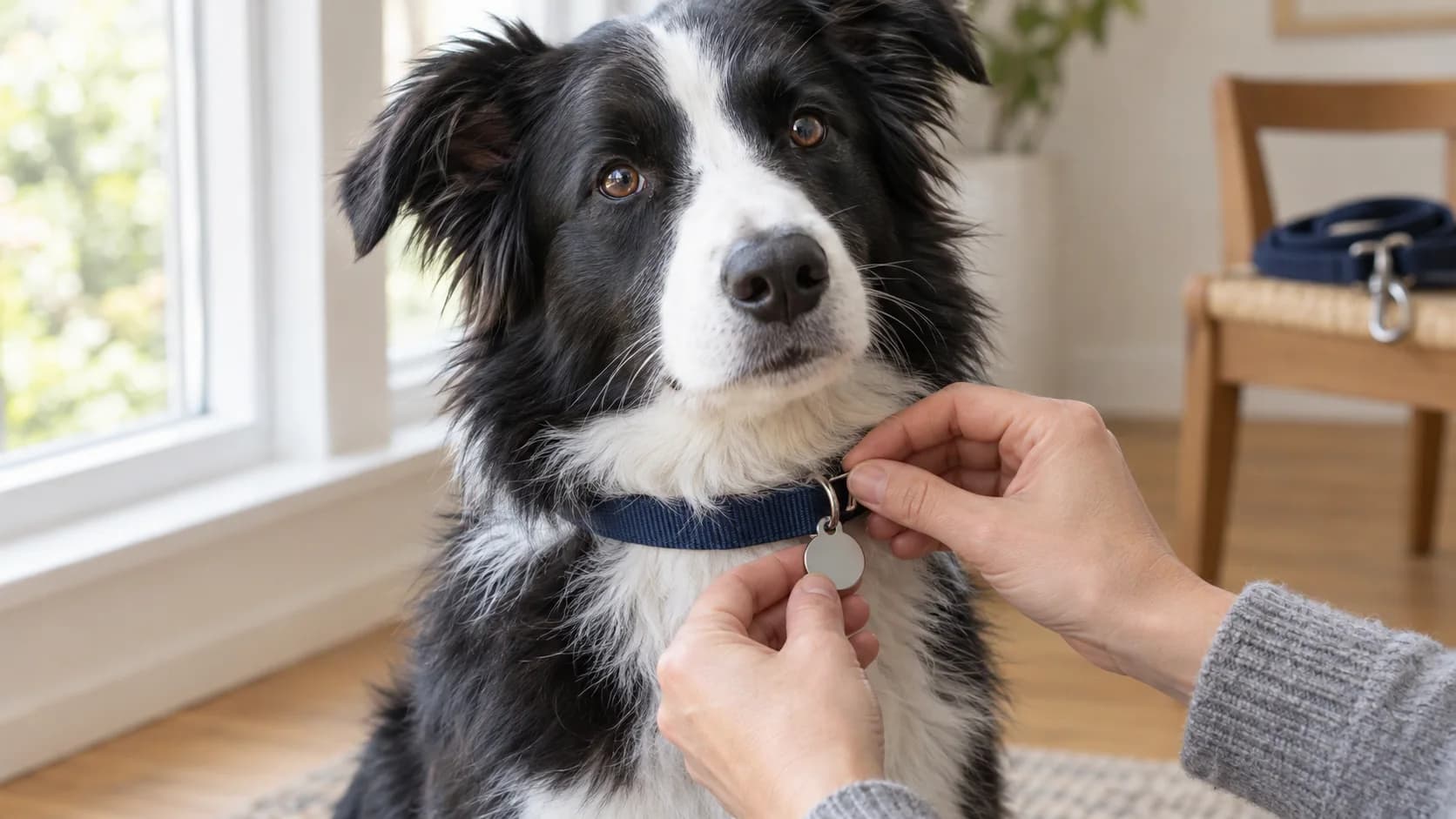
Put a phone number you will answer on your pet's ID tag. In the UK, a dog's collar or tag must also show the owner's name and address whenever the dog is in a public place. In the US, add your name and current phone number, and follow local rules on licence tags. If there is room, a second phone number is the most useful extra line.
A tag works because anyone can read it. A neighbour who finds your dog in their front garden can call you in minutes, without visiting a vet for a microchip scan. That only helps if the details are current and still legible, so this guide also includes a quick check you can do today.
What to put on a pet ID tag: the quick answer
Tags usually hold only a few short lines. For a UK dog, the owner's name and address are legal requirements, so a phone number comes next. For a US dog or a cat anywhere, put the phone number first.
| Detail | UK dog | US dog, or a cat anywhere |
|---|---|---|
| Owner's name | Required by law | Recommended |
| Address | Required by law; include the postcode | Optional; many owners use city or ZIP only |
| Mobile phone number | Strongly recommended | Essential |
| Second phone number | Useful if space allows | Useful if space allows |
| Short care note, such as "Needs medication" | Only if it changes what a finder should do | Only if it changes what a finder should do |
| Pet's name | Optional; guidance differs (see below) | Optional; guidance differs (see below) |
If you only remember one thing: the number on the tag must reach someone who will answer it. A beautifully engraved tag with an old number is little help to a finder.
UK: what the law says a dog tag must show
In England, Scotland and Wales, the Control of Dogs Order 1992 says every dog in a highway or "place of public resort" must wear a collar with the name and address of the owner on the collar itself or on a plate or badge attached to it. Not doing so is an offence. The Order exempts some working dogs, including dogs being used for sporting purposes, police work, emergency rescue and herding, as well as dogs registered with Guide Dogs.
Microchipping does not replace the tag. GOV.UK's microchipping guidance says that if you have a dog, it "must still wear a collar and tag with your name and address when in a public place."
The law does not require a phone number, but animal charities recommend one. Dogs Trust's puppy checklist says your current name and address must be on the collar or tag and recommends adding your phone number too. The RSPCA also recommends including your mobile number, because it can help reunite you quickly. Dogs Trust's first-walk guidance describes the address as including your postcode.
In Northern Ireland, dogs need a licence and, separately, a collar showing the owner's name and address. NI Direct's dog licensing page says dogs "must wear a collar with the owner's name and address inscribed on it, or on a plate or badge attached to the collar", with a maximum fine of £1,000 for not doing so. The legal duty is set out in the Dogs (Licensing and Identification) Regulations (Northern Ireland) 2012.
Two practical points follow from the wording:
- Collar plates count. The law allows the details to be inscribed on the collar itself, so an engraved collar plate is an alternative to a hanging tag.
- Harness walkers should still think about the collar. The legislation talks about a collar. If your dog walks in a harness, the simplest way to meet that wording is for them to wear a collar with a tag as well.
US: contact tags, licence tags and rabies vaccination
In the United States, there is no single national rule about what an ID tag must say. Guidance from animal-welfare groups focuses on making your pet easy to return. The ASPCA recommends that all pets, "even indoor-only pets", wear a collar with an ID tag that includes your name, current phone number and any relevant contact information.
Your dog may carry up to three different tags, and each has a different job:
| Tag | What it does | Who sets the rules |
|---|---|---|
| Personal ID tag | Lets a finder contact you directly | Your choice of wording |
| Licence tag | Links your pet to a licence held by the local authority | City or county; some areas, such as Los Angeles County, license cats as well as dogs |
| Rabies vaccination tag | May be provided by your vet after vaccination | State and local rules vary |
Local licensing rules can be specific. New York City requires all dogs to be licensed, with the licence attached to their collar in public. Los Angeles Animal Services says dog licence tags must be fixed to a collar or harness and worn whenever the dog is off the owner's premises. A licence is valid only once the required rabies vaccination certificate is provided.
A licence tag can help someone trace you, but a finder usually has to contact the agency that issued it, often during its opening hours. Your personal tag gives them a direct route. Check your city or county animal services website for the rules where you live.
Should you put your pet's name on the tag?
Reputable organisations disagree. The American Kennel Club lists your dog's name among the details to consider for a tag. In the UK, Battersea's dog-theft advice says to include your name and address and "avoid putting your dog's name on the disc."
A finder does not need your pet's name to call you. A name can help a stranger calm and reassure a nervous dog. It can also make it easier for someone to call your dog away from you, which is the concern raised in theft-prevention advice.
A practical way to decide:
- If space is tight, use it for contact details first.
- If theft is a concern where you live, leave the name off and use the space for a second number.
- If your pet has a care need, a short note such as "Needs medication" is more useful to a finder than a name.
Example ID tag wording you can copy
Replace the bracketed placeholders with your own details. Keep each line short so the engraver can use a readable text size. These layouts are templates, not legal advice for your exact situation.
UK dog, standard round tag (England, Scotland, Wales or Northern Ireland):
[INITIAL. SURNAME]
[HOUSE NUMBER, STREET, POSTCODE]
[MOBILE NUMBER]
UK dog, larger tag or collar plate with a backup number:
[INITIAL. SURNAME]
[HOUSE NUMBER, STREET]
[TOWN, POSTCODE]
[MOBILE] / [SECOND NUMBER]
US dog or cat:
[YOUR NAME]
[MOBILE NUMBER]
[SECOND NUMBER]
[CITY, STATE] (optional)
Pet with a medical need:
[MOBILE NUMBER]
[SECOND NUMBER]
NEEDS DAILY MEDICATION
PLEASE CALL
Before you order, print the wording at the actual size of the tag. If you have to squint, cut a line. A shorter tag that can be read across a garden is better than a crowded one that needs a magnifying glass. Ask the supplier whether deep engraving is available, because shallow lettering can become hard to read over time.
Medical needs, travel and temporary tags
Care notes: The AKC suggests medical or behavioural information as an item to consider. Keep it to what a finder needs to act on, such as "Needs medication" or "Deaf". Full details belong in a phone call with you or a vet, not on a public tag.
Travel: Add a temporary tag with a number that works where you are staying when you take your pet away from home. Include the international dialling code if you are abroad. If your pet goes missing while you are travelling, our away-from-home contact worksheet helps you organise local help.
Pet sitters and kennels: If someone else is caring for your pet, make sure the number on the tag will be answered while you are away. That could mean keeping your own phone on or adding the carer's number to a temporary tag. Agree this before you leave; our guide for pets missing while pet sitting explains why a quick, reachable contact matters.
Smart and QR code tags: These can link to an online profile. A finder may not have signal, may not trust an unknown link or may not think to scan it. Make sure a phone number is engraved too. In the UK, a dog's name and address still need to appear on the collar or tag.
ID tags for cats: collars, safety and microchips
The collar-and-tag rule described above applies to dogs. For cats in the UK, the legal requirement concerns microchips: GOV.UK says cats in England must be microchipped and registered by 20 weeks old, including cats that usually stay indoors.
Whether a cat should wear a collar is a genuine judgement call, and expert advice differs:
- International Cat Care says that "in an ideal world, a cat would not wear a collar because there are safety risks", and calls microchipping the safest and most permanent identification.
- Cats Protection recommends microchipping as the best way to be reunited. If your cat does wear a collar, it says quick-release or snap-opening collars are the safest. These are more likely to pop open if the collar gets caught.
- The ASPCA says outdoor cats should wear a safety collar and an ID tag, and that a tag or microchip can help an indoor or outdoor cat return home.
Advice on elastic collars also differs. The ASPCA describes a safety collar with an elastic panel. International Cat Care and Cats Protection both advise against elasticated collars and prefer a snap-open buckle.
One US trial adds useful evidence. In a study of 538 owned cats fitted with new collars, Lord and colleagues found that 72.7% kept the collar on for the full six months. Eighteen cats (3.3%) got a front leg or the collar caught, either on an object or in their mouth. The researchers recommended identification collars for all cats, with microchips as important backup identification.
Our practical summary: microchip your cat and keep the registration current, whatever you decide about a collar. If your cat wears one, choose a snap-open design made for cats, ask your vet to check the fit and replace a damaged collar straight away.
Visible ID matters for cats partly because finders often assume a cat outside has a home nearby. In a large survey of missing cats, 11% of the cats found alive were inside someone else's house. Our guide to how far lost cats travel explains where cats were found and how to plan a search.
ID tag, microchip or tracker: which does what?
Each type of identification solves a different problem. They work best together.
| ID tag | Microchip | GPS tracker | |
|---|---|---|---|
| Who can read it | Anyone | A vet, shelter or warden with a scanner | You, through an app |
| Can it fall off? | Yes, with the collar | No, it is implanted | Yes, with the collar or harness |
| What it needs to work | Legible, current details | Current registry details | Battery, signal and often a subscription |
| Main job | Direct contact from a finder | Permanent identification | Location information |
Humane World for Animals argues that a microchip is essential backup but should never be the main form of identification. It explains that reading a chip needs a special scanner that "your neighbor down the street" will not have. UK charities put more weight on the chip. The RSPCA points out that collars and tags can be caught or removed, while a microchip identifies your pet permanently. Both points are true, which is why the answer is a tag and a chip.
Keep the tag and the chip record consistent. When you check your microchip registration, compare the phone number with the one on the tag. For a closer look at trackers and Bluetooth tags, see our guide to GPS trackers, Bluetooth tags and microchips.
What research says about ID tags and lost pets
Two US studies from Ohio looked at how lost pets got home.
In a study of 187 lost dogs, Lord and colleagues found that only 48% had any identification when they went missing, counting ID tags, licence tags, rabies tags and microchips together. Of the 132 dogs recovered, 24 were returned through their licence tag. Dogs with a licence tag were more likely to be recovered. Contacting or visiting an animal agency was also associated with recovery.
A companion survey of people who had found a lost pet showed a large gap between species. Finders traced the owner of 46% of the dogs, but only 3% of the cats. Information on a pet tag was one of the routes by which owners were found, alongside animal agencies, newspaper adverts, neighbourhood searches and signs.
These studies were small, local and published in 2007, so the exact figures may not apply where you live today. They do show two consistent patterns: many lost pets had no identification at all, and finders struggled most to trace the owners of cats.
Check your pet's tag in two minutes
Tags wear down, phone numbers change and rings open. Do this check today and again whenever your details change.
- Read it at arm's length in normal light. Can you read every digit without turning the tag to catch the light? If not, replace it.
- Call the number on the tag from another phone. Does it ring, and would you answer an unknown caller? If your phone silences unknown numbers, a finder's call may never reach you.
- Check the voicemail. A greeting that includes your name reassures a finder that they have the right number.
- Compare the tag with your microchip record. The phone numbers should match.
- Inspect the attachment. Make sure the ring holding the tag is fully closed and the collar is not frayed or cracked.
- Check the collar fit. A collar that slips over the head can be lost; one that is too tight is uncomfortable. Ask your vet if you are unsure.
- Update after any change. After a move, new phone number or change of keeper, replace the tag on the same day you update the registry.
Keep a clear, recent photo of the tag with the collar. If your pet goes missing, you can describe exactly what it looks like to shelters and helpers.
If your pet is missing now
A tag can only help once someone finds your pet, so start the search and reports straight away. Mark your pet missing with the microchip registry, contact local services and search close to home. Our step-by-step plans for a lost dog and a lost cat cover the first calls and checks.
Include the collar and tag in your description: colour, shape and what is engraved, without publishing your full address. You can create a free missing-pet report so helpers have one photo, description and contact route to share.
If you have found a pet with a tag, call the number if it is safe to do so. If the tag is missing or unreadable, our guides for a found dog and a found cat explain who to contact for a microchip scan.
Common questions about pet ID tags
Is a microchip enough without an ID tag?
For UK dogs, no: the law requires a collar showing the owner's name and address in public, even if the dog is microchipped. For other pets, a microchip is permanent identification but needs a scanner to read. A tag lets the person who first finds your pet call you directly.
Do I have to put my full address on a UK dog tag?
The law requires the owner's name and address on the collar or on a tag attached to it. Dogs Trust describes this as your name and address with postcode. If space is limited, use a larger tag or an engraved collar plate. Ask your local council's dog warden service if you are unsure what is acceptable.
Should a US tag include my home address?
It is optional. The ASPCA recommends your name, current phone number and any relevant contact information, and the AKC lists an address as one item to consider. Many owners use the space for a second phone number instead, because a phone call is usually the quickest way for a finder to reach you.
Does my indoor cat need an ID tag?
The ASPCA recommends ID tags even for indoor-only pets, because an indoor cat that gets out is in unfamiliar territory. UK cat charities put microchipping first and treat a collar as a choice that carries some risk. Whatever you decide, keep the microchip details current. If your indoor cat has already got outside, follow our indoor-cat escape checklist.
How often should I replace my pet's ID tag?
There is no set schedule. Replace it whenever the engraving is hard to read, the attachment is worn or any of your details change. Doing the two-minute check every few months, and whenever you update your microchip record, catches most problems before they matter.