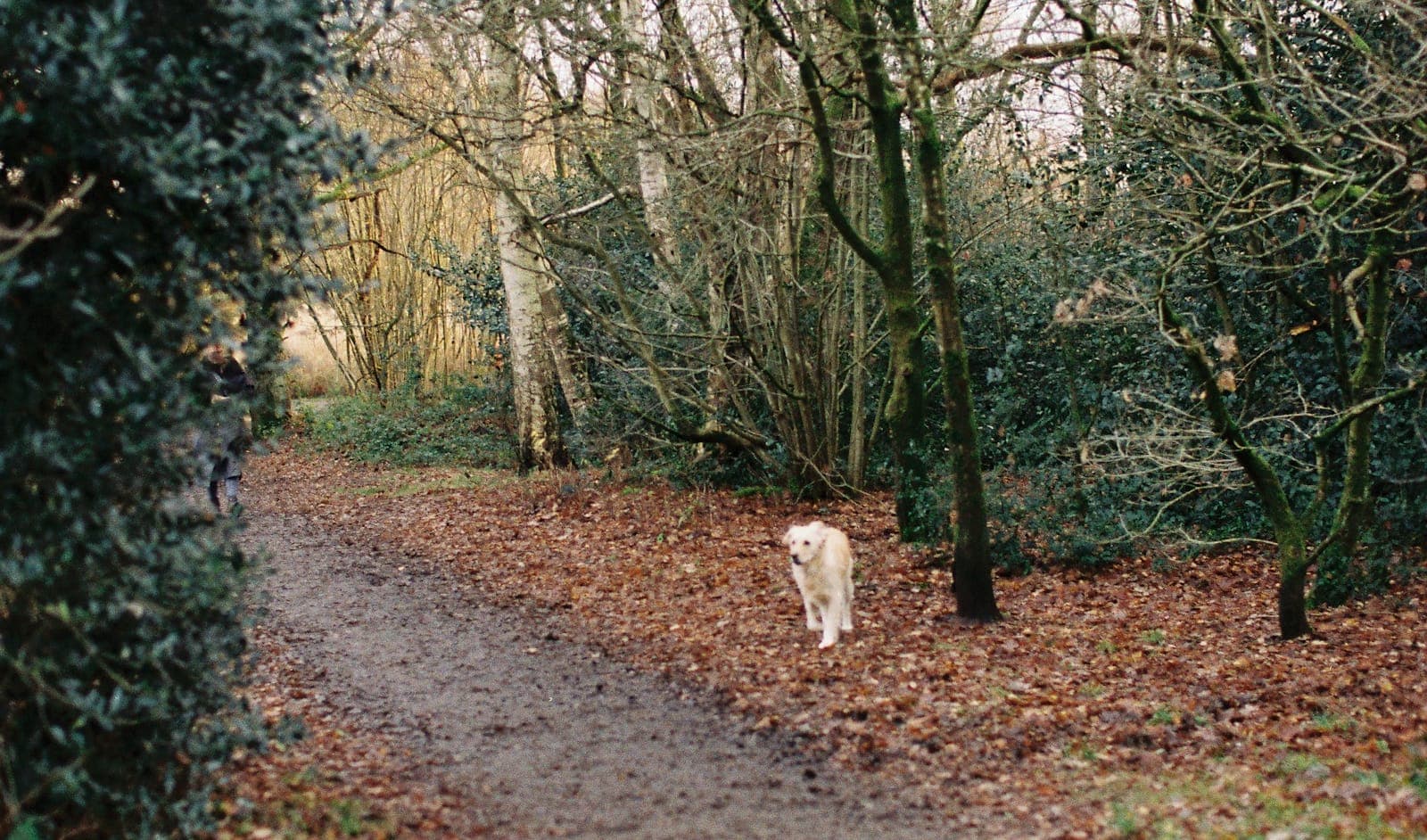
A lost dog can travel miles, but some stay close to where they disappeared. There is no reliable miles-per-day rule that tells you where your dog is. Start at the last confirmed location, check nearby places thoroughly and widen the search using sightings, accessible routes and reports from local services.
The question is understandable: you need to decide where to put your time. A useful search plan keeps two things moving together: a careful physical search in places supported by evidence, and a wider appeal that helps people report your dog if they turn up elsewhere.
If your dog has just disappeared, use our lost-dog first-day checklist for the calls and reports to make while you work out the search area.
What affects how far a lost dog goes?
The Missing Animal Response Network identifies temperament, the circumstances of escape, weather, terrain, appearance and population density as factors in travel distance. It describes frightened dogs that keep moving and avoid people, while approachable dogs may be picked up near the escape point. A dog's behaviour when lost can differ from their usual behaviour at home.
These factors are clues, not a formula. Use them to prepare questions for the people helping:
| What you know | What to investigate |
|---|---|
| Someone saw your dog run along a path | Where does that path lead, and who can check it safely? |
| Your dog disappeared near houses | Has anyone taken in a dog or checked an enclosed garden? |
| There was a fright, collision or fireworks | What direction was actually seen, and where was sight lost? |
| Your dog was wearing a lead or harness | Are there accessible places along the known route where it could catch? |
| A finder may have put the dog in a vehicle | Which vet, shelter or animal service might they have contacted? |
Age, health and mobility also belong in your missing-dog description. Share any urgent care needs with local services, but do not use an older dog's usual walking distance to dismiss a possible match.
Why a circle on a map is only a starting point
A map radius measures straight-line distance. A dog following a winding path covers a different distance, and a dog taken to a shelter in a vehicle may be found far beyond the area they walked through.
Draw the connections as well as the circle: footpaths, gardens, park exits, underpasses and the streets leading from the last sighting. Mark places helpers cannot access. A road or river is a reason to plan safe checks on either side when there is a lead; it is not proof your dog stayed on one side.
For example, imagine a dog last seen beside a park gate. Checking the homes backing onto that park and asking the grounds staff about sightings gives you specific jobs. Sending everyone to the edge of an arbitrary five-mile circle can leave the park itself unchecked. This is a planning example, not a prediction of where a particular dog will be.
Build a search map from confirmed sightings
Use a paper map or a shared digital map. One person should maintain the record so old reposts do not become new sightings.
- Pin the escape point and time. If nobody saw the escape, label it as the last confirmed location instead.
- Give each sighting a separate entry. Record where the witness stood, where the dog was and when it happened.
- Attach the evidence. Keep the original photo, identifying markings and witness contact details in a private record.
- Mark uncertainty. Use separate labels for confirmed, possible and ruled out. A similar coat colour alone does not confirm a match.
- Assign a follow-up. Each lead needs a named helper and a next action, such as contacting a property owner or checking camera footage with permission.
Record times in full. “Seen this morning” becomes confusing when a post is shared tomorrow. Our dog-sighting question sheet helps turn a call into information you can use.
Do not draw a continuous route between two unconfirmed sightings. Keep both leads open until photographs, timings or other identifying details support the connection.
When should you widen the search?
Widening the appeal and moving every searcher are different decisions. You can notify more people while a helper continues nearby checks.
| New information | Useful next action |
|---|---|
| A credible sighting outside the current area | Verify the time and markings, then arrange safe observation there |
| Several reports refer to the same old photograph | Trace the original report before moving the search |
| A nearby building or garden remains inaccessible | Arrange access; keep it on the unfinished list |
| No sightings after the first searches | Review which places were actually inspected and broaden local contacts |
| Someone reports picking up a similar dog | Ask where it was taken and contact that organisation directly |
In the UK, Dogs Trust recommends contacting neighbouring local authority areas as well as your own. For practical reporting routes, use our UK guide or US guide. Do not exclude a shelter listing solely because it is outside your original search radius.
Ask people to report sightings without chasing
More people seeing your dog is useful; several people pursuing them can make recovery harder. Humane World for Animals advises asking witnesses not to chase and warns that chasing a skittish dog can drive them out of the area.
You can add this to your appeal:
If you see a possible match, please call [number] with the exact place, time and direction of movement. A photo from a safe distance is helpful. Please do not chase or gather around the dog.
For a frightened dog that cannot be approached safely, share repeated sightings with local animal services or an experienced recovery organisation. Never send helpers onto a railway, into traffic or across unsafe ground.
Common questions about lost-dog distance
How far can a dog travel in 24 hours?
There is no dependable daily distance for a missing dog. Multiplying a running speed by the hours missing assumes continuous movement in a useful direction. It does not account for hiding, resting, obstacles or being picked up. Use the latest reliable location to guide the next search.
Could my dog still be nearby after several days?
Yes, nearby places can still be relevant. Time alone does not confirm that your dog has moved farther away. Keep a record of unfinished checks and follow new evidence, including credible sightings elsewhere.
Should I choose a larger advertising area because my dog can travel far?
An advertising area controls who may see an appeal; it does not locate your dog. Choose outreach using the disappearance location and useful sightings. You can publish a free missing-dog report to keep one shareable record of the details while the physical search continues.